

EEA Adds to Growing Library of Effective Practices, Impact Measurement
 Since its formation in the summer of 2025, the Enterprise Engagement Alliance’s Impact Council has published eight guides to effective design practices and measurement consistent with practices long proven in the world of total quality management (TQM).
 Click here to subscribe to RRN weekly, and here for an RRN media kit.
With a growing body of independent research proving the financial impact of stakeholder engagement, the Enterprise Engagement Alliance earlier this year launched the Impact Council, an effort to build an authoritative library of research, case studies, and expert interviews on effective practices in program design and measurement.
This growing collection of articles serves as a practical knowledge base for practitioners, suppliers, consultants, and organizational leaders seeking to adopt TQM-consistent, transparent, and outcome-driven engagement strategies. As the field continues to mature, the EEA remains committed to providing tools, guidance, and thought leadership that elevate practice and improve results across industries.
Here is a list of the latest impact articles.
1. How to Assess the True Impact of Incentive, Recognition, Loyalty and Related Engagement Efforts
A foundational guide explaining why traditional metrics—such as participation rates or satisfaction scores—are insufficient for meaningful evaluation. This article introduces a fuller impact framework that considers behavioral change, performance outcomes, financial return, and alignment with strategic goals based on proven TQM principles.
2. Channel Engagement YouTube show: Trust, Holistic Design, Impact Measurement Essentials
This video-based discussion explores how trust, transparency, and holistic program design directly influence channel performance. The show highlights the shift from transactional incentive structures to relationship-driven engagement and explains why measuring trust and partner experience is critical.
3. Mastering the Measurement of Incentives, Rewards and Recogniton.
A practical guide for organizations seeking to quantify the value of reward and recognition programs. It outlines key measurement categories—including behavioral change, performance outcomes, cultural indicators, and business results—and provides templates for capturing both qualitative and quantitative data.
4. How to Measure a Channel Engagement Strategy
This resource focuses on the unique metrics required for distributor, reseller, and partner engagement. It addresses challenges such as data visibility, shared accountability, and aligning incentives with multi-step sales processes. The article offers a simple, repeatable measurement model for channel ecosystems.
5. How to Measure a Holistic Approach to Employee Engagement Design
Rather than viewing engagement as a set of disconnected programs, this article promotes a systems-based evaluation model tied to organizational purpose and culture. It covers metrics across leadership, communication, learning, well-being, and recognition, helping organizations assess engagement as an integrated strategy rather than isolated initiatives.
6. Driving With Both Eyes Open: Why ROI of People Management Is the Next Business Imperative
This thought leadership piece explains why organizations must measure the financial and operational outcomes of human capital initiatives with the same discipline applied to finance or operations. It makes the case that people-related metrics—when tracked systematically—are leading indicators of future performance and enterprise value.
7. Human Capital Metrics Investors Should Know
Investors and analysts increasingly expect organizations to disclose standardized human capital data. This article outlines the most relevant metrics, including turnover costs, engagement trends, productivity indicators, leadership development, and workforce capability. It connects these measures to long-term value and risk assessment.
8. The Financial Case for Recognition
This article summarizes research showing how strategic recognition programs drive measurable business outcomes, such as reduced turnover, stronger discretionary effort, higher customer satisfaction, and operational gains. It provides guidance on calculating ROI and aligning recognition with organizational objectives.
9. The Compelling Benefits of Permission Marketing and Why They Remain Overlooked
How to use permission-based marketing to build better relationships with customers and prospects and better measure the results of your marketing.
Enterprise Engagement Alliance Services
Celebrating our 15th year, the Enterprise Engagement Alliance helps organizations enhance performance through:
1. Information and marketing opportunities on stakeholder management and total rewards:
ESM Weekly on stakeholder management since 2009; click here for a media kit.
RRN Weekly on total rewards since 1996; click here for a EEA YouTube channel on enterprise engagement, human capital, and total rewards insights and how-to information since 2020.
2. Learning: Purpose Leadership and Stakeholder
 Management Academy to enhance future equity value and performance for your organization.
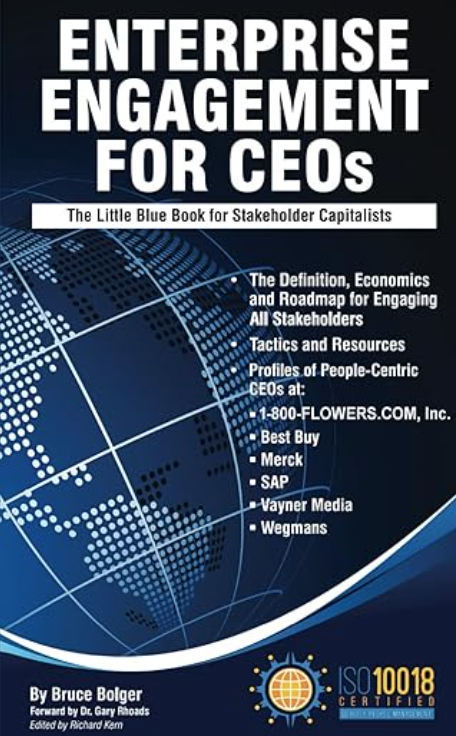
3. Books on implementation: Enterprise Engagement for CEOs and Enterprise Engagement: The Roadmap.
4. Advisory services and research: Strategic guidance, learning and certification on stakeholder management, measurement, metrics, and corporate sustainability reporting.
5. Permission-based targeted business development to identify and build relationships with the people most likely to buy.
6. Public speaking and meeting facilitation on stakeholder management. The world’s leading speakers on all aspects of stakeholder management across the enterprise.